Locked emotions
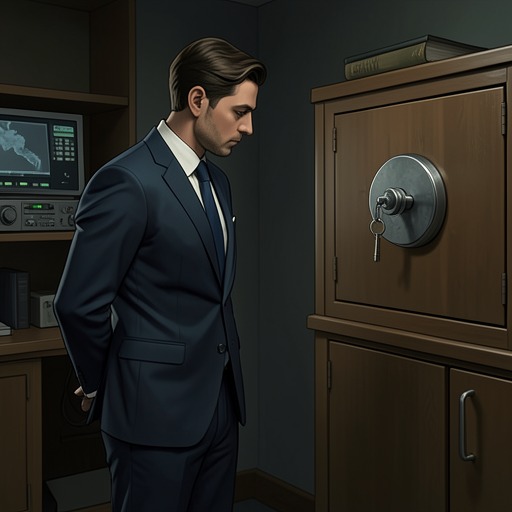
Love VirtuallyThe idea of locked-away feelings is the governing metaphor for the tension between Leo Leike’s emotional self-control and Emmi Rothner’s insistence that his attachment to her is real but confined. In their rapid exchange, feelings become something stored in trunks and closets, guarded by a key Leo calls common sense. Emmi counters that a key which only locks cannot make those feelings safe: it leaves them trapped, unable to breathe or emerge. The image carries their correspondence toward its approaching meeting at Café Huber, where the private world they have made through writing is meant to reach a conclusion in person.
The metaphor of storage and restraint
When Emmi asks whether Leo feels anything as he writes to her, she explains that she fears he feels nothing, and that this impression hurts. Leo answers not with denial but with abundance: he has vast trunks and closets full of feelings for her. Yet he also claims to possess the keys to lock them away. The contrast is central to the image. His feelings are not absent; they are plentiful, but held apart from expression and action.
Emmi immediately tests what the key represents. She wonders whether it comes from Boston and whether it is called Pamela, connecting Leo’s restraint to his life beyond their correspondence. Leo rejects that specific explanation: his key is universal and goes by the name of common sense. The exchange does not establish that Pamela is the actual source of his self-control; instead, Emmi’s question exposes her suspicion that his feelings may be locked away for reasons attached to the life he has elsewhere, while Leo presents restraint as a general principle.
Common sense and the argument over feeling
The two writers assign opposite functions to common sense. For Leo, it ensures that his feelings always get enough air. His account treats containment as protection: emotion can remain alive without being allowed to take over his conduct. The metaphor therefore does not simply oppose feeling to reason. Leo presents reason as the means by which feeling survives without spilling into a form he cannot manage.
Emmi disputes that reassuring version. In her reply, the key turns in only one direction: it closes things. The feelings inside the closets, she says, are beginning to suffocate. She expands the image from a set of hidden rooms into an entire warehouse of closeted feelings, then tells Leo that he needs to work on them. Her criticism distinguishes preservation from freedom. In her view, keeping emotion alive in secret is not enough if it can never leave its enclosure.
The disagreement remains unresolved rather than becoming a shared diagnosis. Leo insists that common sense gives his feelings air; Emmi answers that they still cannot get out and are never free. Their exchange makes the same inner state legible in two incompatible ways: as emotion sensibly contained, or as emotion imprisoned by a rule that permits no release. The metaphor captures their intimacy precisely because each can speak about the feelings while disagreeing about what those feelings are allowed to become.
The correspondence as a space for emotional testing
The image develops through unusually quick, successive emails. Emmi’s question is followed by Leo’s declaration of abundance, her suspicion about Boston and Pamela, his naming of common sense, and their opposing accounts of what the key does. The brief intervals give the exchange the feel of a live argument: each reply revises the meaning of the previous one, and neither writer lets the other’s explanation stand without challenge.
That exchange also displays the particular freedom and limitation of their written intimacy. Emmi can ask directly whether Leo feels anything, and Leo can confess to a storehouse of feelings, but the confession does not itself open the locked rooms. The correspondence allows them to name, interpret, and contest emotional restraint; it does not settle what either will do beyond the messages. The image of the key therefore describes both Leo’s stated self-management and the boundary between what the pair can write and what they have yet to enact.
The approaching meeting
Emmi returns to the locked-feelings image in her message headed “Two days to go.” She says she will send no further email until Leo writes first, but adds that if he does not reply she will still see him the day after tomorrow at Café Huber. Her planned wait is deliberately composed: she says she will sit at a small table apart from the crowd, rather than search the café with a crazed look in her eye. She imagines the meeting as the end of an adventure of the mind, built through two years of correspondence in which they have built and dismantled feelings, before Leo decamped to Boston and locked away his feelings for her.
The metaphor thus arrives at a threshold. The meeting is meant to bring their correspondence to a fitting conclusion, but Emmi’s description of Leo’s locked feelings leaves open whether he will allow the emotional relationship to cross from writing into face-to-face recognition. She asks him to identify her among three versions, supplying descriptions of each: one petite and quick-moving, another tall and blond, and a third medium-height and brunette, shy and melancholic. Her final reminder to take care of his key turns the earlier argument into a pointed, unresolved challenge. The feelings have been named; whether they can be freed remains uncertain.